Thursday, July 13, 2023

Fantasia International Film Festival 2023 - Preview

Fantasia International Film Festival
27th Edition
July 20th - August 9th, 2023

By “Doc” Hunter Bush, staff writer and podcast czar


Returning for its 27th Edition, this July 20th - August 9th, the Fantasia International Film Festival is Montreal, Québec, Canada’s cavalcade of unique yet universally exciting films, most of which would otherwise go unnoticed by your average audience. Fantasia grew out of a love for Asian genre cinema into a renowned festival dedicated to “creating bridges between the cutting edge and the mainstream”. Focusing on genre films from around the globe, usually of the lower budget, lower profile variety; in short, the kinds of films that don’t get wide release marketing pushes unless they’ve won accolades from somewhere like Fantasia. Over the years the festival has been a beloved destination for fans and filmmakers alike, warranting glowing praise from, among others, the world’s foremost ambassador of genre film - Guillermo del Toro, who referred to Fantasia as “a shrine”. Personally, I have been lucky enough to have numerous mind-expanding, breathtaking, eye-popping film experiences within Fantasia’s program.

This year’s lineup is as borderline overwhelming as ever, and it feels like they’re announcing more movies every day! Below I’ve assembled a selection of the films that have grabbed my attention with both fists for one reason or another and will be at the top of my To Watch list once the festival kicks off. I’ve divided them into some loosely defined “categories” to help me keep track of them, and to help showcase the width and breadth of Fantasia’s 2023 offerings, with my main pick set apart.


_______________________________________ Horror ________________________________________

When I think “genre” I think “horror” and this year’s Fantasia has almost too much horror on offer. For instance: A queer filmmaker finds herself as the only one who can detect the parasites taking over a small town in T Blockers from eighteen year-old filmmaker Alice Maio Mackay (her third feature!). The new film Perpetrator from Jennifer Reeder (who you may know from Knives and Skin) sounds bewitching: on the eve of her eighteenth birthday, a troubled teen girl experiences a magical metamorphosis due to a familial enchantment which will aid her in searching for the person responsible for a series of disappearances at her school. Then there’s In My Mother’s Skin from director Kenneth Dagatan: the first film co-produced by the funding boards of three countries (the Philippines, Singapore, and Taiwan), it follows a young woman whose attempts to protect her dying mother are undermined by her misplaced trust in an evil fairy.


Then there’s the Sundance hit Talk to Me which has been the, no pun intended, talk of the town. Following a group of Australian teens dealing with the fallout from a seance involving an embalmed hand, Talk to Me is being described as one of the scariest films in recent years. It also has a creepy kangaroo jump scare in the trailer, which immediately hooked me!


______________________________________ Animation ______________________________________

For as long as I’ve been aware, Fantasia has featured a treasure trove of all kinds of animation. Without even discussing the short films (always a haven for unusual animated projects), this year’s festival is no different. The steampunk detective adventure Kurayukaba is set around a train traveling the dreamlike tunnels beneath a metropolis. Animated in a traditional anime style with 3D elements like the train, this looks extremely intriguing and mysterious. The Chinese feature Deep Sea looks staggering and whimsical, achieved in part by using “a cutting-edge digital particle-animation technique” that emulates an ink-wash painting style to tell the tale of a young girl seeking answers from within by traversing an oceanic dream world. Then there’s the box office record breaking sports anime The First Slam Dunk, the first addition to the super popular Slam Dunk franchise in 33 years! It’s about basketball, in case you didn’t realize.


The film that most caught my attention however, is Mother Land. A stop-motion modern fable from South Korea set in the Siberian tundra, it follows a young girl traveling into the unknown wilderness in search of an old spirit who may be able to heal her mother. Though the animation is not unlike the work of Laika studios, it doesn’t seem nearly as whimsical, coming across as more solemn and mystical. It’s giving me almost a Studio Ghibli tone. Most intriguing of all, it’s South Korea’ first stop-motion animated feature in 45 years! I’m very excited to see what inspired writer/director Park Jae-beom to break the streak.


______________________________________ Romance ______________________________________

As a hopeless romantic and genre fan, I’m always on the lookout for cool, genre-bending love stories. The Becomers seems like just the thing: starring a pair of body-swapping aliens who’re just trying to find their place on our planet. What’s not to love? Then there’s My Animal, a queer horror drama (co-starring Amandla Stenberg from Bodies Bodies Bodies) that “flips the script of Ginger Snaps”; very intriguing. Another that caught my eye was With Love and a Major Organ, a high-concept sci-fi commentary on dating in the age of apps, which has a truly batnanas plot description. Any movie where the female lead rips her heart out AND THAT’S when things start to get rough? You have my attention.


The love story I’m most looking forward to is Killing Romance. Another truly unique description, this “madcap musical comedy” follows a once-popular actress and her student neighbor (who also talks to animals) as they decide to eliminate her controlling husband so she can mount a career comeback. Even if she and the neighbor don’t fall in love during their misadventures, there’s nothing like seeing an awful relationship come to a hopefully hilarious end to make you appreciate your own loved one(s).


______________________________________ Popcorn _______________________________________

Some movies try to convey a message, while some endeavor only to entertain. Some even manage to do both. Empire V follows a student invited to join an elite group that turn out to be vampires. The trailer is filled with enthralling visuals (and a breathy pop cover of Muse’s Knights of Cydonia), features fascinating world building, and has apparently been banned in its native Russia due to the presence of anti-war Russian rapper Oxxxymiron in a co-starring role. Wild stuff. Meanwhile Hideaki Anno’s Shin Kamen Rider, following the creation of the titular grasshopper-themed superhero, has all of the visual punch with none of the oppressive politics. Then there’s The Sacrifice Game, director Jenn Wexler’s sophomore feature about two students at an all-girls school in the 1970s defending themselves against cultists when left alone during the holidays. I wasn’t able to find a trailer for this one, but if it’s anything like her 2018 feature film debut The Ranger, it’s sure to be entertaining. Whether or not these deliver on deeper meaning, they certainly seem like a blast simply to watch.


The same could be said for my top choice. Making its North American premier, Vincent Must Die follows the seemingly unremarkable title character who finds himself under assault from almost everyone he encounters for seemingly no reason. Described as a mix of genres, including horror, comedy, romance, fantasy and thriller, the premise alone seems like enough to keep my eyes glued to the screen for two hours.


____________________________________ Favorite Actors ____________________________________

Compiled from films from around the world, the Fantasia lineup is an embarrassment of riches when it comes to their casts. Even so, It’s always a pleasant surprise to see a favorite familiar face in the cast list. Perennial genre fan (and fan favorite) Nicolas Cage co-stars as The Passenger alongside Joel Kinnaman as The Driver in Yuval Adler’s carjacking thriller Sympathy For the Devil. The flick looks intense, so buckle up. On the other end of the spectrum is Aporia, a time-bending bit of speculative sci-fi starring living legend Judy Greer as a woman who lost her husband in a drunk-driving accident and teams with the husband’s physicist best friend to experiment with a new technology the two had been developing, which may be able to fix things for them all. Finally there’s Nick Stahl, a talented actor who kept almost breaking into the mainstream through the late ‘90s and early 2000s and has been making a strong comeback in the last few years. His performance in Fantasia thriller What You Wish For is being described as “a career best” playing a chef with a gambling problem who adopts the identity of a wealthy friend. Love that for him.


Then there’s David Dastmalchian who is one of the most interesting character actors of the last few years (and it’s a crowded field). In Late Night with the Devil, he plays late night television host and recent widower Jack Delroy during a disastrous live broadcast in 1977 that unleashes evil into the homes of his viewers. Stephen King has said that the flick is “absolutely brilliant” which is enough for me to move it directly to the top of my list.


_________________________________ Last Drive-In Alums __________________________________

Some of the films at this year’s Fantasia come from filmmakers who’ve had movies featured on Shudder's The Last Drive-In, hosted by Joe Bob Briggs and Darcy the Mail Girl. These include genre mainstay and dare I say legend Larry Fessenden, whose lycanthropy horror thriller Blackout finally allows him to reimagine familiar werewolf movie tropes in much the same way as he’s approached vampires in Habit (1995) and Frankenstein’s monster in Depraved (2019). The familial collective the Adams family - mother/father/daughter team Toby Poser, John Adams and Zelda Adams - follow up their breakout feature Hellbender (2021) with the depression era film Where the Devil Roams which follows a family of sideshow performers searching for eternal life. Both films have piqued my interest, due in part to Joe Bob Briggs’ interviewing the filmmakers during their respective episodes. Hearing the filmmakers talk about making their films, and seeing them get to be themselves really endeared them all to me, much the way that a good fanzine interview would.


Though he wasn’t interviewed by Joe Bob, director Joe Lynch’s ultraviolent workplace revenge actioner Mayhem (2017) was similarly featured on an episode of The Last Drive-In. His Fantasia entry Suitable Flesh is being described as a “loving tribute to the late Stuart Gordon”. Gordon is a favorite filmmaker of mine, and Lynch is treading in familiar Gordon territory by adapting H.P. Lovecraft’s story The Thing on the Doorstep into a film starring Heather Graham as a psychiatrist who becomes infatuated with a young patient of hers (Judah Lewis) who exhibits otherworldly symptoms. Nobody realized Lovecraft’s stories and characters in quite as post-psychedelic a fashion as Stuart Gordon and I’m legitimately very excited to see Joe Lynch’s approach. Suitable Flesh also stars Bruce Davison, Jonathan Schaech, and Gordon collaborator and legend Barbara Crampton.


___________________________________ Special Projects ____________________________________

Fantasia frequently plays host to unique projects like film restorations, special screenings and idiosyncratic events. This year is no different with a book launch for the genre anthology Haunted Reels, featuring readings from authors in attendance like Jay Baruchel, C. Robert Cargill, and Benson & Moorhead, plus others! There’s also a Canadian Trailblazer Award presentation for filmmaker Larry Kent, which includes 4K restorations of three of his most seminal films: The Bitter Ash (1963), Sweet Substitute (1964), and When Tomorrow Dies (1965). I was unaware of Larry Kent, even by reputation, but in researching him in relation to this award, I’m now very keyed up to check out his work. 


In a similar vein, this year’s Fantasia will host the world premier of The Primevals, from special effects whiz David Allen. When a sasquatch-like creature is encountered and killed, and its skeleton eventually brought back to civilization, a team of explorers set out to find a living specimen and end up in a lost valley that time forgot where there are even more creatures than they expected! Allen’s credits include special and visual effects work on everything from Q the Winged Serpent (1982), to Willow (1988), to Ghostbusters II (1989), to The Arrival (1996) and, importantly, the large chunk of the Full Moon Films universe, including the Puppet Master series, Subspecies series, and more. Basically every film you’ve ever seen where the quality of the stop-motion effects had vastly outpaced the film that contained them. Conceived in the ‘70s and begun in the ‘90s, The Primevals was to be David Allen’s magnum opus for Full Moon. Sadly, production stopped when Allen passed away in 1999. But now it will finally be realized, using the original assets and finished with guidance from Allen’s own storyboards. I’m sincerely so excited that this film will finally be seen!


Vive les films !

Tickets for the 27th Fantasia International Film Festival can be purchased HERE.

Monday, July 10, 2023

FILW Trios Championship recap (March 2023)

Flickering Image League Wrestling
Trios Tag Team Championship Match

Crimes of Passion pay-per-view recap

By Hunter Bush & Bryan Bierman

It was a result few wanted, but it’s the one we got.

Monsters Inc. have captured the FILW Trios Tag Titles from the grasping hands of The Three Amigos last night at the Crimes of Passion pay-per-view event in Mahoning, PA, after a hard-fought and bloody match. After largely being kept out of action on the ring apron, Nacho headed up a tenacious offense that rallied the crowd and his stable mates, but was ultimately outgunned by their hard-hitting opponents and pinned. Many in attendance voiced their displeasure and a rain of half-empty soda and nacho cheese cups fell upon the celebrating trio.


The FILW Trios Tag Championship belts had been held for 267 days by the Mega Mountain faction composed of Thunderlips, Rip Thomas, and Sean Armstrong. After claiming them at the Judgement Night ppv (Augusta, GA) in June 2022, the trio cut a bloody swath through the competition, frequently ending matches with their trademark three-man powerbomb, High Noon at Mega Mountain. Unfortunately, injuries suffered at the Tuff Turf ppv (Boston, MA) in the beginning of this year required the titles to be vacated. An eight team iron man elimination tournament was held at last month’s Rumble in the Bronx ppv (New York, NY), setting the card for last night’s match.


Monsters Inc. formed in 2022 when former singles wrestler Bonesaw McGraw joined the imposing but rarely dominant tag team of the Revolting Blob and Captain Insano, then known as Better Off Dead. Taking the name Monsters Inc., the injection of new blood revitalized and refocused the former BOD, and the trio actually challenged for the Trios belts but were soundly beaten by Mega Mountain. This led them down a dark path and every victory they have accrued since has been marred by underhanded tactics and copious cheating.


The Three Amigos had each individually been languishing on the singles circuit before forming as a surprise entry into the elimination bracket at Rumble in the Bronx. Randy the Ram was a near-superstar in the 1980s but a string of injuries and a spotty attendance record had robbed him of his glory in the intervening years. Jimmy King was much more recently a champion but hadn’t held a title since the 2000s. The lucha libre wrestler Nacho, a comparative newcomer, has quickly become a fan favorite but still hadn’t managed to make much headway as a singles competitor. Somehow, at Rumble in the Bronx, their multigenerational mix of styles and talents allowed them to persevere throughout the night and emerge as the favored team to take the titles.


Randy the Ram and Bonesaw opened last night’s match, drawing on their brief history in the mid-’90s at another promotion, the highlight being Randy delivering his signature Ram Jam diving headbutt from the top rope that sent Bonesaw into the opposite corner. Jimmy King and the Revolting Blob engaged in a decent if unremarkable stretch of technical wrestling before King failed to connect with his Crown maneuver (a double axe handle strike). Tagging in, Capt. Insano showed no mercy, opening up a can whoop-ass on King with his giant fists, leaving King bloodied and gassed in the center of the ring.

Bonesaw baited Randy to the top of the ramp and the Blob kept Nacho busy, pulling him down off of the ring apron and sitting on his head at the moment that King was able to rally enough to attempt the tag. Eventually the tag was made and the crowd popped to their feet. The David vs Goliath visual of Nacho squaring off against Insano, the smallest and largest of the six men respectively, is quite a sight. Nacho held his own, wearing Insano down and allowing King to catch his breath before the two men tagged and traded opponents, with Nacho diving majestically down on the Blob, still on the outside, and a bloodied, screaming King delivering the Crown to Insano.

The cheers from the crowd were deafening, but short-lived as Insano used his massive form to block the view of the referee while Bonesaw and Blob double teamed Nacho before dragging him and a badly battered Randy back into the ring and delivering their version of Mega Mountain’s triple powerbomb finisher. King ate the pin and the new Trios Champions were presented with their belts.

With Wrestlevania looming in the near future (June 6th, 6 PM at Philadelphia PA’s 2300 Arena; tickets still available), it’s interesting to see where things stand with the titles. Monsters Inc. ending the match with Mega Mountain’s finisher is an obvious taunt, and could lead to the former champions returning to reclaim their titles as underdogs. It’ll be interesting to see what, if anything happens with the Three Amigos. They’re obvious fan favorites but it’s unclear if they’ll even remain a team. I guess we’ll see at the Wild at Heart ppv in April (Missoula, MT; tickets still available).


_____________________________________________

This piece was written for MovieJawn, a fabulous site where you can find tons of other excellent movie-centric writings, a shop where you can subscribe to the quarterly physical zine, or listen to me on the  Hate Watch/Great Watch  podcast! Support the MovieJawn Patreon here!

_____________________________________________


Wednesday, June 7, 2023

HOPPING MAD: the MR. VAMPIRE sequels Boxed Set (Eureka Entertainment)

HOPPING MAD: THE MR. VAMPIRE SEQUELS
Special Edition Two-Disc Blu-Ray
Comprising:
Mr. Vampire II a.k.a. Vampire Family (1986)
Mr. Vampire III (1987)
Mr. Vampire Saga IV a.k.a. Uncle Vampire (1988)
(Part V) Vampire Vs Vampire (1989)
Directed by Ricky Lau (2 - 4), Ching-Ying Lam (5)
Written by Barry Wong (2), Cheuk-Han Szeto (3), Wing-Keung Lo (3 & 4), Kam Cheong Chan, Chi-Leung Shum, Mei-Yee Sze (5)
Starring Ching-Ying Lam, Richard Ng, Billy Lau, Fong Lui, Pauline Yuk-Wan Wong, Anthony Chan, Wu Ma, & many, many more!
Running times between 1 hour, 26 minutes (shortest), and 1 hour, 36 minutes (longest)
From Eureka Entertainment

By “Doc” Hunter Bush, Staff Writer, Podcast Czar

Synopsis:

In 1985, the Ricky Lau directed horror comedy Mr. Vampire was released to much success, with a subsequent installment following each year from 1986 - 1989. Now, for the first time, all four sequels (BUT, it should be noted: NOT the original) are collected in one boxed set! The films as a series take an anthology approach to being a franchise; each film is its own thing, with actors playing similar archetypes across multiple entries, but have no specific hard & fast continuity.

Mr. Vampire II features an archeological dig unearthing a family of vamps (mother, father, son) and shenanigans ensue. In Mr. Vampire III a Taoist priest pulling an exorcism scheme not unlike Michael J. Fox’s from The Frighteners runs afoul of a cabal of horse thieves led by a for-real witch. Shenanigans ensue. Mr. Vampire Saga 4 is a Grumpy Old Men -style rivalry between next door neighbors, one a Taoist priest and the other a Buddhist monk. A vampire does eventually show up llate in the game, with shenanigans ensuing both before and after. Vampire Vs Vampire sees yet another Taoist priest attempting to cleanse a mountain town only to run afoul of a European-style vampire. Do shenanigans ensue? You betcha.

A Little Table-Setting:

Chinese vampires - or jiangshi - are different from western vamps. They’re undead corpses, but more in the zombie vein because they operate on instinct, locating victims by sound or sight instead of strategy. They hop rather than fly, and while they do bite, they feed on energy instead of blood and only bite as an attack. Their bites and scratches can eventually turn a victim into one of them, but there are numerous esoteric ways to fend off the transformation.

They’re based on descriptions of men hauling groups of preserved dead bodies by tying their arms to long bamboo poles with the living man in the lead, pulling them along. His lurching, hauling gate gave the corpses the appearance of all jumping in unison along the roads at night, searching for unwary travelers.

What Features Make it Special:

  • 1080p HD from brand new 2K restorations (Mr. Vampire II and Mr. Vampire III)
  • 1080p HD from brand new HD restorations (Mr. Vampire IV and Vampire vs Vampire)
  • Cantonese and English audio options on all films
  • Optional English subtitles for all films, newly translated for this release
  • Brand new feature length audio commentaries for Mr. Vampire II and Vampire vs Vampire by Asian film expert Frank Djeng (NY Asian Film Festival)
  • Brand new feature length audio commentaries for Mr. Vampire III and Mr. Vampire IV by action cinema experts Mike Leeder & Arne Venema
  • Brand new video piece discussing the history and resurgent popularity of the Jiangshi genre
  • Trailers
  • Reversible sleeve featuring original poster art
  • Limited Edition O-Card slipcase featuring new artwork by Darren Wheeling (first 2000 copies)
  • Limited Edition collector’s booklet feature new writing on the films and the Jiangshi genre by James Oliver (first 2000 copies)

Why You Need to Add It to Your Video Library:

For fans of genre oddities, this is the proverbial candy store for you to feel like a kid within. The films themselves are incredibly unique and interesting with tons of cool wirework, slick choreography, goofball antics, numerous practical effects, beautiful design work, and rich worldbuilding and lore. The sets and costumes are beautiful, and the stunt work is largely just incredibly impressive. I can’t imagine any four films that would offer up this varied an assortment of distinctive bits: limboing chains of corpses, deep fried fat golems, chemicals that make you move in slo-mo, and a ghost forced into the body of a soldier and hypnotized to attack anyone wearing a Taoist’s robe, which the ghost/soldier sees as a giant eagle!

Y’all. I am not kidding. If this were a bare-bones set with ONLY the films, it’d be worth picking up (provided you’ve got access to a region-free player), but Eureka Entertainment have crafted an absolute embarrassment of riches. The transfers look incredible; crisp and with lovely colors throughout, and the sound mixes are dynamite. I personally l-o-v-e lore and worldbuilding, and one of the bonus features is an interview with an actual Taoist priest, Kelvin a.k.a. Sam Fai, who explains the origins behind some of the weapons and tactics most frequently-used against the jiangshi! It was absolutely fascinating and made me want to research even more about some of these beliefs. Beyond that, there are commentary tracks for each of the films which I’m sure are all packed with even more tidbits and anecdotes, but I’ve not had the luxury of watching them all quite yet. 

You don’t NEED to have seen the original Mr. Vampire to appreciate the weirdness, the creativity, the absolutely bonkers choices you’ll see in these four films. Ghosts stretching their limbs, a TV sitcom-style musical number for a child vampire, a vampire fight in a quicksand-filled swamp; I could list things all day and still not accurately convey how surprising these movies are. I honestly never stopped smiling through any viewing of any film in the set.

If you’re a fan of films like Evil Dead II, The Frighteners, Ghostbusters, House (1977), or are just curious about the jiangshi hopping vampire genre in general, you owe it to yourself to make space on your media shelves for Hopping Mad. And, for completists like myself, they’ve got the original on blu-ray too.


Hopping Mad: The Mr. Vampire Sequels boxed set is available HERE from Eureka Entertainment

Friday, March 17, 2023

"A LITTLE WHITE LIE" (2023)

A LITTLE WHITE LIE (2023) will make you doubt Michael Shannon, but not the way it wants to

Directed by Michael Maren
Written by Michael Maren (based on the novel Shriver by Chris Belden)
Starring Michael Shannon, Kate Hudson, Don Johnson
Running time 1 hour, 41 mins
Rated R for language

By “Doc” Hunter Bush, Podcast Czar

I am a bit bewildered by A Little White Lie, but not in the ways this mistaken identity film aims for. The film, adapted from a novel and directed by first time feature director Michael Maren, is being described as a romantic comedy and while those elements are somewhere in the meandering story, they’re never emphasized effectively.

Based on the novel Shriver by Chris Belden, it stars Michael Shannon as a guy named Shriver - a New York City janitor - who is invited to speak at a west coast college campus’ annual literary conference because they believe he is the reclusive author of the polarizing novel Goat Time, a man who is also named Shriver. Instead of playing up the mistaken identity angle, Janitor-Shriver immediately tells conference organizer Simone (Kate Hudson) the truth, but since she is desperate to keep the annual event going, year-to-year, she opts to have him perpetuate the lie to avoid controversy and embarrassment.

Once at the conference he refuses to be cool or to keep a low profile. He almost immediately tells a reporter that he is in fact not the writer. He insults two members of the conference’s inner circle and we have no idea why. He asks Blythe (Aja Naomi King), a female poet, if she has ever considered writing from a male perspective, which she understandably rankles against, becoming confrontational and suspicious towards him. He insults Sophie (Peyton List), a sculptor who is also Blythe’s partner, by saying that her medium (cake) is “odd”. She justifiably calls out what seems like bigotry from him - he has been exposed to the works of two queer women, and had nothing to offer aside from “Why can’t you make it something I would like?”.

When Blythe disappears after an impromptu late-night party in Janitor-Shriver’s room, instigated by the classics-quoting, Canadian tuxedo-clad T. Wasserman (Don Johnson), Janitor-Shriver becomes the prime suspect because apparently Goat Time includes allusions to the murder of the main character’s ex-wife. This information doesn’t receive much ado for the audience. Janitor-Shriver just mutters something along the lines of “oh, really” and never really treats it like a big deal despite a suspicious Sophie calling in an investigator (Jimmi Simpson) to get to the bottom of things.

Eventually, after showing an affinity for poetry and off-hand, even wry humor, Janitor-Shriver decides that he is, in fact, Writer-Shriver …just in time for a man claiming to be the real Writer-Shriver (Zack Braff) to show up. When I say that none of these scenarios or revelations are treated like a big deal, what I mean is: this movie is described as a romantic comedy. The romance feels completely perfunctory but that’s nothing special - I could throw a rock at my movie collection and hit a dozen comedies with relatively useless romantic subplots, but those still function as comedies, because they take a scenario and emphasize the comedy in it.

Janitor-Shriver pretending to be an author who may have killed his ex-wife and confessed to the crime through his work? That could be funny. Him deciding that he IS the author, only for someone else to show up making the same claim? That could be funny. But neither thing is inherently funny.

Inherently, those two scenarios could be ANYTHING: a John Grisham-esque thriller where the art circle are analyzing microfiche for clues; a Kafkaesque nightmare of confused identity and occulted legal repercussions; it could even BE a romantic comedy, but that takes direction. The film and filmmaker have to steer things to where they want them to go. That’s why there are so many “When you really think about the events of (some comedy film) it’s really a horror film” posts that get reposted across the web all the time. Not just that there are many different ways to view events, but that most people wouldn’t have considered the alternative angles because these other films are doing their job.

As an example: Groundhog Day (1993) - a film which also features Michael Shannon, btw - takes a much crazier scenario (a man repeating the same day over and over with no idea how or why) and continually steers it towards comedy, leaning just enough into the existential horror of things for contrast, to make the comedy work even better. A Little White Lie never takes the reins, so events just kind of happen.

Michael Shannon’s choice to play Janitor-Shriver as awkward - not really making eye contact, muttering a lot of his dialogue - would be fine if everyone else was dialed up a few notches higher on the caricature scale. Kate Hudson for one, plays things far too straight; more Gossip (2000) than Glass Onion (2022). Simone could conceivably be frazzled from trying to keep a lid on things while also coordinating an entire conference, and then potentially lovestruck with Janitor-Shriver because I guess that’s a thing. Which isn’t to say the two don’t have chemistry, but there’s no moment that shows sparks flying between the two. Janitor-Shriver just thinks Simone is better looking than Mark Boone Junior who plays his only real friend back in New York. Simone in turn likes that Janitor-Shriver reads some of her writing and is very complimentary. I don’t really think either of these things constitute real “romance”, but that is admittedly a judgment call.

A Little White Lie suffers from a very common problem in first films: lack of a clear voice. Everything I’ve pointed out above is just an example of mediocre-to-bad filmmaking which feels like the production lacked a deft hand. It’s a romantic comedy where the romance is undeveloped and the comedy at times feels actively avoided. The cast’s performances aren’t calibrated to any specific tone or style, or to play well off of each other, so while there are winning moments and interactions, the movie doesn’t know what to do with them. I can’t even tell what the POV of the story is. What is the script saying by juxtaposing the working class Janitor-Shriver with the comparatively frivolous personalities of the California aspiring artist community? Not much.

For a brief moment, I thought this might borrow from Being There (1979), a film also based on a novel with a similar fish-out-of-water set-up. In Being There, a socially insulated gardener is suddenly thrust into the world of politics where his non sequiturs about plant care are viewed as elegant and insightful political metaphors. When Janitor-Shriver asks if Blythe has considered writing from a male perspective, or calls Sophie’s choice to sculpt in cake “odd”, it would have been an opportunity for them or someone else to see some koan of logic within these critiques, but no one does.

The greatest sin of A Little White Lie is that it made me doubt Michael Shannon, who I sincerely view as one of the best actors around. Here, he's completely unengaged as an actor, and gives an unengaging performance as a result. I worried: Had the man known as ‘Big Chicago’ lost a step after decades of under the radar dynamite performances? Thankfully, I immediately watched George and Tammy (a six episode miniseries on the lives of George Jones and Tammy Wynette, on Showtime) which not only gets my heartiest endorsement, but features top tier acting from Shannon.

A Little White Lie features brief shining moments - the camaraderie between T. Wasserman and Janitor-Shriver; the performance of Da’Vine Joy Randolph as Delta, a fellow conference attendee and author - which get drowned out in a muddled mix of also moments and also characters. Maybe the book is better? Just watch George and Tammy, you’ll thank me.


A Little White Lie is available in theaters, and on digital, and on demand on Friday, March 3rd.

Sunday, January 22, 2023

"COCKAZOID" (2022)

Cockazoid (2022)
Written by Nick Verdi, B.R. Yeager
Directed by Nick Verdi
Starring Jimmy Laine, Ethan Hansen, Franklin Statz
Running time 1 hour, 26 minutes

By “Doc” Hunter Bush, MJ Podcast Czar


It’s finally turning cold in Philadelphia after a unseasonably late turn from the warm weather. And oddly I find my mind returning to a flick I caught a few months back at this year’s Philadelphia Unnamed Film Festival. Cockazoid is a very uncomfortable film, as emotionally cold as the Massachusetts landscape it takes place in, but I find it exceedingly fascinating. It’s been sitting in the back of my mind since the screening ended, a sinister hum undermining my every quiet moment.

Cockazoid is the brainchild of director/co-writer Nick Verdi (co-written with author B.R. Yeager) and it’s …unsettling to say the least. Andrew (Jimmy Laine) is a loner. A disaffected young man who, it is obvious from the film’s opening moments, has become untethered from reality. He travels back to his hometown using a family tragedy as an excuse but his ultimate goal is to kill all the white men (not unlike himself) in Massachusetts. While he doesn’t even come close to achieving his goal, he comes a lot closer than most people ever would.

Now, I’m going to say something that might sound really odd: This movie is very funny. It’s super dark in tone, and filled with an almost continual sense of dread. The kills in the movie are brutal and the kind of low-budget explicit where the unrealism of them makes them more horrific - watching Andrew attempt to dismember a victim’s corpse in the woods with just a pocket knife and some random stick he found on the ground is kind of nauseating but it’s also hilarious in its futility. It’s why butchers don’t cut meat with a Swiss Army knife. It’s only because this is a film; because you can see that the torso he’s mutilating is fake, that it’s funny at all.

There’s a kind of sick humor in Andrew himself. He’s so cartoonishly incompetent and socially impotent that to even compare him to any type of specific mindset feels like an insult. He’s a cautionary tale. What sadly occasionally does really happen when extreme, deep-seeded mental illness and the kind of self-aggrandizing keyboard warrior mindset get too high on their own supply and think their fantasies of being some kind of philosophical warrior for a higher truth are in any way connected to reality. It’s the kind of thinking we see whenever any mass shooter or aspirant serial killer’s manifesto comes to light.

That’s also what I found most interesting in Cockazoid. Andrew’s inner monologues contain just glimpses into his beliefs, if you can even consider them actual, capital-B “Beliefs”. These brief bits of his headspace seem as unrelated to each other as they are to reality. One moment he’s rattling off statistics: how many white men live in Massachusetts, how much square footage the state has available for him to bury his army of victims, etc., and in the next moment he’s fantasizing about retiring to the afterlife to live in a mansion with a roof shingled in their teeth. This seemingly constant flux of his core motivation makes Andrew both more frightening and more pathetic in equal measure. Does he just want to kill for the sake of killing or is he hiding behind the scapegoat of a nebulous “greater purpose”.

I’m trying not to overuse the word “fascinating”. Just because it’s bad writing, not because I’m worried what you’ll think of my being fascinated by Cockazoid. I think the point of Cockazoid is to be fascinated by it. And disgusted, in equal measure.

The filmmaking is incredibly well done. Everything, everywhere feels cold. There’s hardly a moment where the tension or discomfort is allowed to ease up. The neighborhoods, woods, and fields of Massachusetts feel labyrinthine and claustrophobic. There are occasional peeks into Andrew’s early life that are shown as degraded and warped VHS home videos in his mind’s eye, a format that is inherently off-putting no matter what’s shown, but with the feeling of a horrific impending revelation looming, it becomes nail-biting.


Jimmy Laine’s performance as Andrew is just as incredible. There’s something to be said for a performance that isn’t afraid to be ugly that’s absolutely commendable when it fits the subject matter this well. As a character, Andrew has hyped himself up to the point that he almost has to kill someone or else admit that maybe the problem isn’t the entire world, maybe it’s just him. But once he’s done it, he has to justify it, which leads him back to the same place, mentally. And around and around it goes. As a performer, Laine’s large eyes bulge and shift, his motions are ungainly and awkward, the internal struggle he is having is clearly depicted at all times.

Not that I see myself as any great tastemaker, but I hope this article can help generate a little buzz about this film. It really should be seen. I reached out to director Nick Verdi, and as of yet he has gotten no real response about getting Cockazoid any proper distribution, which is honestly a disappointment. It’s not a film for everyone, nor is it one I could see myself rewatching every year - it’s much too unpleasant for that - but it’s still a film I’d like to own. I’d like to be able to show it to people (certain people who would appreciate/could handle it). It’s honestly a masterclass in low-budget filmmaking, in maintaining a very specific tone, in managing that sense of dread; all things that (especially) horror filmmakers should have access to. I hope it becomes more readily available soon.

Just as a footnote: the film’s title, as Verdi explained after the screening, is a derogatory term for white people (a bastardization of “caucasoid”), which I only mention because it’s not explained in the film itself, but I think it’s a fabulously perfect title in how the meaning and the almost creature-like imagery it conjures perfectly coalesce in the themes of the film.


Cockazoid is currently unavailable to view but hopefully that will change.
In the meantime, watch the teaser trailer for Sweet Relief, Nick’s next project, here on YouTube.
Support small films. Long Live the Movies.


____________________________________________


.This piece was written for 
MovieJawn, a fabulous site where you can find tons of other excellent movie-centric writings, a shop where you can subscribe to the quarterly physical zine, or listen to me on the  Hate Watch/Great Watch  podcast! Support the MovieJawn Patreon here!

____________________________________________

Friday, January 13, 2023

The PHRANCHISE of the OPERA (1989 - 1999)

The Phranchise of the Opera:
In which I throw flowers on stage for an under-seen horror franchise

By “Doc” Hunter Bush, MovieJawn Podcast Czar


In 1989 director Dwight H. Little (whose Halloween 4 was released the previous year) unleashed a then-new version of The Phantom of the Opera on the world. Based on the novel by Gaston Leroux, it stars Robert Englund (A Nightmare on Elm Street franchise) as Victorian composer Eric Destler, and Jill Schoelen (Popcorn, The Stepfather) as modern-day aspiring opera singer Christine. When Christine uncovers the notation for Destler’s composition Don Juan Triumphant as well as rumors of his involvement in many deaths and disappearances, she still decides to perform the piece for an audition and is subsequently knocked unconscious and awakens in 1885. After surviving numerous attempts on her life and well-being by Destler, and simultaneously pursuing an opera career in 1885, Christine returns to her own time believing Destler is dead, only to find that he has survived for a century due to a deal with the devil, and is now the producer of her opera, Mr. Foster. Christine steals his copy of Don Juan Triumphant, stabs Foster, and flees into the night.

Phantom ‘89 didn’t reinvent the horror wheel but it did enough things right that it spawned a seemingly little-known franchise spanning seven DTV (direct to video) sequels - eight total films in just ten years! - that rivals the highs and lows of horror franchises of the era, like Halloween, Friday the 13th, and Hellraiser. It also perfectly encapsulates where franchise horror was in the years between the boom of the 1980s and its resurrection following Scream in 1996. For better or worse.

The filmography is as follows:
The Phantom of the Opera (1989)  - dir. Dwight H. Little
The Phantom of the Opera 2: Terror of Manhattan (1990) - dir. Peter Lyons Collister
The Phantom of the Opera 3: Miseria Cantare (1991) - dir. Kinka Usher
The Phantom of the Opera 4: Nocturne (1994) - dir. Marc Forster
The Phantom of the Opera 5: O, Discordia (a.k.a Fear of Sound) (1996) - dir. Dick Bachmann
The Phantom of the Opera 6: The Last Canticle (1997) - dir. Risa Bramon Garcia
The Phantom of the Opera 7: Cacophony (1998) - dir. Alejandro Amenábar
The Phantom of the Opera 8: Epoch Dirge (1999) - Tony Trov, Johnny Zito

I won’t go into extensive detail about all of them, but there are some areas of the Phranchise of the Opera (as I think of it) which are absolutely worth noting. First of all, the films’ various directors are an interesting bunch. Horror has, and was especially in this era, a proving ground for aspiring filmmakers and the assorted Phantoms’ directors went on to direct a very diverse crop of films including Mystery Men (1999 - Usher), Monster’s Ball (2001 - Forster), The Others (2001 - Amenábar, who had directed Abre Los Ojos in ‘97), Alpha Girls (2013 - Trov, Zito), and 200 Cigarettes (Garcia). The only outliers are Peter Lyons Collister - Dwight H. Little’s cinematographer on Halloween 4, and the original Phantom ‘89 - who has a long cinematography career but never returned to directing, and Bachmann who just kind of vanished?

Likewise, horror tends to have a high turnover of new, relatively unknown talent. Before Scream became the phenomenon that it would eventually become, horror (especially of the franchise kind) was of a low enough priority that casting well-knowns wasn’t seen as very important which combined with the generally high character turnover rate, meant that most sequels featured less than 3 returning characters - though there are exceptions. Phantom ‘89’s original final girl Jill Schoelen only shows up in three of the sequels, while Englund bats a thousand appearing in all eight films in the Phranchise! Molly Shannon, who had a small supporting role in the original, actually reappears in The Last Canticle (1997) with no direct mention of the events of the original film. Other notable cast members appearing across the sequels include Christina Ricci (Wednesday from the ‘90s Addams Family movies), Jane Weidlin (Clue, The Go-Gos), Calvert DeForest (Larry Bud Melman from The Late Show with David Letterman), Mos Def (Monster’s Ball), Jennifer Rubin (Taryn from A Nightmare on Elm Street 3: Dream Warriors), Pat Maztroianni (Degrassi franchise), Gabrielle Union (Bring It On), Taran Noah Smith (the youngest brother from Home Improvement) Lee Pace (recently of Bodies Bodies Bodies - more on him later), and weirdest of all given his eventual popularity, an uncredited, dialogue-less appearance from Philip Seymour Hoffman (Twister).

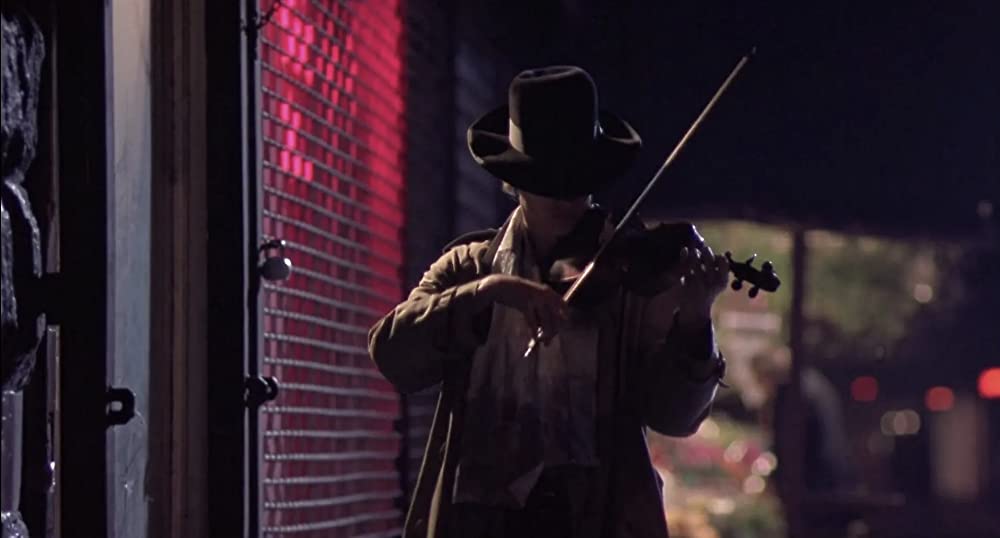
The plots of the sequels were at the best of times what you might call “loosely connected” by the concept of Destler’s music as a destructive force. In the finale of Phantom ‘89, after wounding Destler, Christine passes a street violinist who begins playing Don Juan Triumphant. Terror of Manhattan runs with this idea, with Christine hearing the song everywhere she goes. Haunted by this music, she can’t sleep, and seems to have lost her mind, claiming to have visions of Destler taunting her, narrowly avoiding being committed to an asylum. In further installments, the music is shown to be alternately hypnotic (Nocturne), to be an extension of Destler’s consciousness (Cacophony), or to induce madness in assorted forms (Miseria, Discordia, Canticle, Dirge) and in fact Miseria Cantare revealed that music was the dark art of choice of the demon Destler made his Faustian deal with in Phantom ‘89, implying that the demon was responsible for the dancing plague of 1518 as well as the frenzied phenomenon of Lisztomania. 

When the horror monsters popular throughout the 1980’s reached the 1990’s, things got very weird. The Hellraiser films touched on demonic construction and architecture, The Leprechaun went from space to the hood, Michael Myers was revealed to be the puppet for the druidic Cult of Thorn, and Jason Voorhees, after battling a stand in for Carrie, somehow takes a boat from a lake to NY harbor, and then goes to Hell. It’s a real “IYKYK” situation and describing 1990’s horror to people who don’t can sometimes seem like you’re just making the whole thing up. The Pharanchise of the Opera is no exception. Changing locations from New York to Philadelphia with little explanation (Miseria), not to mention the summer camp in the fictional town of Caramel Hill (Canticle, which filmed in New Jersey, but Caramel Hill’s location is never given), or the sensory deprivation tank-inspired feature length flashback to Destler and Jack the Ripper (Discordia), as well as the shifting tone of the flicks, and the changing effects of Don Juan Triumphant all come out of left field for first-time viewers.

In The Last Canticle, the counselors of a summer music camp (one played by the returning Molly Shannon) teach the children’s choir to sing DJT which somehow doesn’t affect anyone at the camp, but drives the residents of the nearby small town insane turning this sixth film - marketed as the supposed final installment - into a kind of redneck zombie film in which Destler ultimately almost becomes an antihero, sacrificing himself to Hell in the final moments.

The following film, 1998’s Cacophony dips the deepest into Horror/Comedy, opening with Destler in Hell, introducing other spirits who had fallen prey to the demon including ones seemingly based on the original Universal Studios versions of the Phantom of the Opera (1925, 1943), a disfigured ‘70s rock star - seemingly an allusion to Brian De Palma’s Phantom of the Paradise (1974), one that appears to be a reference to Fantômas (the silent film criminal character created in 1911) and Jack the Ripper. They all follow when Destler manages to escape from Hell and he spends the film tracking them down and returning them to Hell with the assistance of a 1998 Lee Pace. The relatively recent rediscovery of noted babe Pace in this bonkers film has even led to a few versions of the popular “Spider-Men pointing” meme.


The last film in the Phranchise, 1999’s Epoch Dirge has had a similar grassroots rediscovery-via-meme. Released on the eve of the new millennium, the film’s plot is a bubbling cauldron of Y2K-fearing hacker clichés where the climax sees the heroes (including Jennifer Rubin) fail to prevent a mass destructive upload that, among other effects sees satellites somehow blasting Don Juan Triumphant at midnight around the globe - the final moments show the astronauts aboard a Mir station stand-in sabotaging the station and steering it towards North America before cutting to black. The series ended on this potential cliffhanger, but the film’s real legacy is the memetic reappropriation via .gif of a particular line of dialogue, similar to Silent Night, Deadly Night 2’s (1987) “Garbage day!” line. In Dirge’s case, a gruff-voiced computer tech (often erroneously identified as Michael Chiklis) says the line “Tha innernet. It’s tha wave of tha future!”

Hilarious as that may be (and it is), the true draw, and what should rightfully be the lasting legacy of the series, is the monster, Eric Destler himself. Robert Englund gradually leans into camp as the Phranchise continues, and by the time he’s in a weird buddy-cop type movie hunting down escaped killers (Cacophony), the series had taken on a tone almost like the Batman series from 1966 but made through a Paul Greengrass-esque lens. The makeup for the Destler Phantom also evolved over time. In the ‘89 Phantom, he looked, well, kinda like Freddy Krueger. It’s hard to say whether this is exacerbated by it being Englund under the makeup or not. But Destler’s version of the traditional Phantom of the Opera mask is one made of human skin, which lends the whole thing a different dimension. Any time the series is flashing back to Destler’s era of 1885, he has this kind of Hannibal Lecter-meets-Leatherface disguise that’s constantly rotting and falling apart. It’s gruesome and wonderful. In his future (1989 and on) he has access to these synthetic appliances; essentially Darkman style false faces. They mostly all resemble Englund/Destler throughout the series, with the exception of one nightmare in Nocturne where the final girl caresses her boyfriend’s face only for her fingers to go right through the skin to Destler’s face underneath, and a gag in Cacophony - again, the most madcap in the series - where he briefly disguises himself as a cop. 

Also, notably for a horror franchise of the era, Destler is mostly just A Guy. He’s never explicitly shown to have supernatural abilities, though you could argue his resilience to bodily harm and instances of nearly superhuman strength might qualify, it’s left fairly open ended, à la Halloween’s Michael Myers (pre Curse of Michael Myers in 1995 with the overtly supernatural Mark of Thorn). Aside from Destler’s implied nearly inexhaustible fortune (the result of his long life? Or possibly another stipulation in his demonic deal?), he has no notable special abilities. He’s essentially a psychopathic Batman.

The logic, plot, and continuity of the Phantom of the Opera's ‘90s Phranchise is tangled and inconsistent, but not any worse than its theoretical shelf-mates like Hellraiser, Friday the 13th, the aforementioned Halloween, or Leprechaun, among many others. As we keep seeing these more well-known franchises getting spotlighted with relaunches, reimaginings, or long-gap sequels, I keep waiting for the moment that light shines on the Phantom. Presumably some version of the Phantom character would have ended up in Universal’s Dark Universe, had that succeeded. But it didn’t, so let’s get weird and musical! I think the Phantom of the Opera (1989) has earned an encore.


_____________________________

Disclaimer:
The preceding article, save the opening paragraph, is entirely a falsehood. While there was a Phantom of the Opera made in 1989 and it is as described, it spawned no sequels despite being actually quite good. This article was written as a thought experiment and celebration of both the kitchen-sink approach to ‘90s horror franchises, as well as a monster, character, and performance I feel has been woefully overlooked.

After first viewing Phantom ‘89, I could not believe it hadn’t caught on and in considering what the ensuing films might have looked like, I conceived the rough approximation of a franchise described above. Would that we all had lived in that world. I hope you enjoyed it, that it may have ignited some creative spark in you, and that you’re not too mad at being ever-so-briefly deceived.

It should be mentioned that a sequel was proposed, but never made and eventually became the film Dance Macabre (1992), also starring Robert Englund.


____________________________________________

This piece was written for MovieJawn, a fabulous site where you can find tons of other excellent movie-centric writings, a shop where you can subscribe to the quarterly physical zine, or listen to me on the  Hate Watch/Great Watch  podcast! Support the MovieJawn Patreon here!

____________________________________________

Sunday, January 1, 2023

"THE OUTWATERS" (2022)

The Outwaters
Directed & written by Robbie Banfitch
Starring Robbie Banfitch, Angela Basolis, Scott Schamell, Michelle May
Currently unrated
Runtime 1 hour, 40 minutes

The Outwaters shows that Found Footage is the Haiku of Horror Filmmaking”


By Allison Yakulis & Hunter Bush


Hunter Bush: Filmmakers are always fighting against limitations. Sometimes it’s an idea that can’t be realized, sometimes it’s having a very slim budget, sometimes it’s just scheduling constraints. Regardless, they’re all roadblocks between a filmmaker and their ideal finished project. Creative filmmakers find ways to not just work around their limitations, but to work with them; use these hurdles to their advantage.

Found footage, as a genre, works within limitations. You don’t need professional gear, actors, or cinematography. The almost user-generated nature of the conceit also allows for narrative gaps that can help with pacing and budget. Even still, within the sub genre of found footage, some films are more inventive or innovative than others. With The Outwaters, writer/director/star Robbie Banfitch may have used the limitations of a young filmmaker more creatively than any other example I can call to mind.


Allison Yakulis: To me, found footage is a genre fraught with mediocre efforts. It has enough structure to delineate it as its own genre, is cheap enough that anyone with access to any sort of camera can film in this style, and when actually done well is considered a triumph in monetizing art as it is, again, cheap and accessible to produce. Of course, when it’s done poorly there’s a lot of shaky camera, often in the dark, to hide seams and give the appearance of a novice photographer, and in some of the most egregious instances it breaks the “rules” and depicts sequences that no camera handheld or otherwise could’ve picked up. Found footage is the haiku of horror filmmaking: beautiful in its simplicity when well-executed, but too frequently lackluster or incoherent due in large part to the perception that anybody can do it.

Overall I enjoyed The Outwaters. In fact, I would argue it’s in the top of its genre, on par with films like The Blair Witch Project (1999), Cloverfield (2008), and Host (2020). When this film hits, it hits hard and cuts deep. Is it a perfect film? No, it’s laggy in parts of the third act with a few nighttime sequences that are too dark and chaotic to glean a meaningful understanding of what is actually going on. In these moments it started to lose me as a viewer. Banfitch carefully arranges his setting, characters, goals, and scope, but when given a slow burn setup I expect a splashy, manic ending. An impartial editing for pace would give the drop-at-the-end-of-the-rollercoaster feeling, rather than the emotional whiplash I felt.

There are moments in this movie that are so arresting, so wickedly gleeful that it’s going to stick with me for years, I can feel it already. 


HB: The basic premise of The Outwaters, just so that we’re all on the same page, is that four friends go into the Mojave desert to film a music video: aspiring director Robbie (Banfitch), his brother Scott (Scott Schamell) who will function as an assistant, hair & makeup stylist Ange (Angela Basolis), and Michelle (Michelle May) the video’s star. Michelle is a singer, and the quartet’s plan is to just film a bunch of beautiful footage of a glamorous looking Michelle in the natural splendor of the Mojave.

Low budget found footage can get a little repetitive, right? There’s usually only a few locations, because they’re shooting on the cheap. Outwaters almost suffers from this but, for my mileage, every time we repeated a gag or location, Banfitch at least tried to make it feel different. The flick is divided up into three memory cards recovered after the film’s events, and things build in a very by-the-book manner. The first card is all preliminaries; getting to know the characters and how they interact. Card two is getting to the desert, filming a music video, and some spookiness that’s light enough to be laughed off the next day. Card three is not just the most concentrated supernatural madness, but it keeps changing; recontextualizing what I thought was going on. To be clear, what I mean is not just what my guesses were for what the movie was, but actually changing what I thought things I had already seen meant.

Early on, having only seen the trailer (which to be fair is mostly darkness, blood and yelling), after the characters find a fire ax stuck into the crest of a low hill, I figured that I was settling in for a The Hills Have Eyes type survival horror. That was a guess and it was wrong. That’s not what I’m talking about. The reliance on darkness (full dark, no stars; absolute blackness) means your mind’s eye is taking fragments of shapes glimpsed in a flashlight beam and trying to use the sonic information being presented (footfalls, scraping across the desert floor, yelling, panting, *noises*, etc) to form an image of what might be happening. Then something else would happen that would change all those mental images. This third act basically functions as that parable of the blind men and the elephant, which I think is fascinating. I won’t go into specifics I guess because The Outwaters should be experienced with the least foreknowledge possible. 


AY: Hunter had also mentioned in our discussions that the conceit of filming a music video allows for more artistic flairs than many other found footage-type films. When you make one of your characters a filmmaker or cinematographer, that can be a really smart move to allow some nice, attractive, old-school camera use to establish setting and dole out some eye-candy before things get weird and shaky. He noticed it, and yes, I really dug that too. It not only fleshes out a character but it gives these early sequences an excuse to be fun and beautiful and light and arresting, improving the overall visual quality of the film and providing a nice counterpoint to the darkness and gore in the latter half.

Tropes or pitfalls, you decide. It’s these very things that take me out of other found footage films that The Outwaters generally executes or subverts pretty well. It makes a lot of smart choices, selecting a beautiful location that photographs excellently and feels remote, going for practical effects and sharp editing, often using suggestion and indirect shooting to let your imagination do the heavy lifting.

How do you feel about found footage as a genre? Do you prefer it steeped in realism? A way to tell a story creatively and within a rigid framework? Or do you find it a difficult style to work within/enjoy as a viewer?


HB: What Allison said about Found Footage being the Haiku of Horror Filmmaking is absolutely spot-on. With The Outwaters, if you get too hung up on the narrative you’d be missing the point. Robbie Banfitch has crafted something that seems very simple, but he’s gotten every ounce of impact from it. What it might lack for you in traditional logic it more than makes up for as a masterwork of form. It truly shows that with enough creativity and sheer will, you can manage fantastic things even when working within constraints.


AY: I think Hunter and I both recommend this movie and I agree that it should be viewed without knowing specifics - it is at its best and most fun when it blindsides you. I think where our feelings diverge is in this third act. I was anticipating similar clarity as in earlier sequences and felt restless when presented with lots of sound and little picture (the lagginess I mentioned earlier) - I didn’t have enough suggestion as to what was going on so these parts started to lose me rather than sharpen my nerves. Yet they would be interspersed with enough weirdness or clear daylight views or, yes, references to earlier locations or events that I could reorient myself into what was still a very surreal “distemporal” narrative; in fact, it really stuck the landing for me and I walked out happy at the end. In summation I think our feelings differ as to whether The Outwaters is a credit to, or the exception in, its horror subgenre.


The Outwaters should be available on Screambox in January 2023, after a limited theatrical run.