Showing posts with label musical. Show all posts

Wednesday, February 19, 2025

THE DEVIL AND THE DAYLONG BROTHERS (2025)

The Devil and the Daylong Brothers
Directed by Brandon McCormick
Written by Brandon McCormick, Nicholas Kirk (songs)
Starring Brendan Bradley, Nican Robinson, Jordon Bolden, Rainey Qualley, Keith Carradine
Running time 1 hour and 52 minutes

by "Doc" Hunter Bush,
MovieJawn Staff Writer & Podcast Director, cohost of the Hate Watch/Great Watch Podcast

The Devil and the Daylong Brothers is a very unique creature. A southern gothic, supernatural road trip action movie with a very specific internal mythology and buckets full of violence, all wrapped in a polished, stylish sheen that makes it very approachable. And on top of that, it's a musical. As I watched this flick, I kept returning to the feeling that it would make an excellent jumping off point for a tv series. And, despite what the nagging voice in the back of my head kept repeatedly saying, there's nothing wrong with that.

TV has steadily closed the respectability gap since at least the 1990s, followed by what would become known as "prestige TV" with shows like The Sopranos (1999-2007), Mad Men (2007-2015) and all those others you couldn't help but hear about around the water cooler. Where once, comparing a film to television would be seen as a massive insult, now it actually depends on the context. When I tell you that The Devil and the Daylong Brothers feels like prestige TV, please understand I mean that in the best ways.

Titular brothers Ishmael, Enoch, and Abraham, (Brendan Bradley, Nican Robinson, and Jordon Bolden respectively) as they explain in the opening musical number, have different mothers, but the same father, who sold THEIR souls to the Devil for personal gains, then disappeared. Now they work, in a roundabout way, for the Devil, collecting on the souls of people who made deals like their pops did. They hope, of course, to eventually have to collect their own father's soul-debt so they can finally locate him and have a long-awaited face-to-face.

And remember, on top of that, occasionally they sing. It's a wild ride.

Yet somehow, it all works. Everything feels like it belongs. The songs all work towards expanding a character's POV or their current emotional state, and they're good; catchy, hummable. They have a pop sensibility which is carried over into the filmmaking itself.

The brothers are introduced via song in a bar scene. Each one gets a verse and a moment, and their character names appear on screen in a brief, animated flourish. This is how the film opens: a bit like a TV series, and mentally I was off to the races. I couldn't stop thinking of shows that this reminded me of: a little bit of AMC's Preacher (2016-2019), a dash of WB's Supernatural (2006-2020), and a healthy dollop of ABC's Cop Rock (1990) on top.

The brothers have a fun interpersonal dynamic on top of the usual push and pull of siblings. Enoch, for instance, is a bit more into violent retribution and relies on his brothers to curb these tendencies, Abe is the trio's bleeding heart who relies on his brothers to draw him out of himself from time to time, and Ish is the only one "allowed" to drive their 1958 Chrysler Imperial named Grace-- and yes, she gets a credit too. They're caricatures initially, drawn in broad strokes that match the pseudo-wild west vibes of being able to walk into a bar, execute a man and carve a piece of his flesh off as proof that his debt has been paid. But over the course of the film, they come into finer detail.

The performances help make them feel more well-rounded of course. Enoch feels the most like the traditional western protagonist-- mostly a man of deeds more than words, with Robison's looming physicality adding to his menace. As Abe, Bolden feels like the wild card, his expressive eyes selling Abe's emotional volatility. For my money, Bradley's performance as Ish is the stand-out. His "Texas Whistle" accent and kooky performance reminded me of an old, sun-addled prospector, which is a character one doesn't often see on a quest for righteous vengeance.

I won't pretend that the whole thing worked for me. There's an odd diversion to include the character of Frankie (a pleasantly vampy Rainey Qualley) that seems intended to add some backstory, but felt like it only slowed things down and added an unnecessary complication. Qualley isn't the problem at all, and the character of Frankie is interesting and reasonably well-rounded, I just don't understand her inclusion in this version of the script. It feels like some bit of connective tissue was excised somewhere along the way.

But that aside, The Devil and the Daylong Brothers is a really pleasant experience. Strong and earnest performances, fun diversions into song, an exciting world with strong roots in folklore, and a really slick stylistic polish. For as many disparate elements as writer/director Brandon McCormick throws in, the finished product is remarkably digestible.


The Devil and the Daylong Brothers is available ll be in Theaters ? ? ? ?, On Digital ? ? ? ? and On Demand ? ? ? ? January 31st, 2025.

Monday, January 31, 2022

"EXPRESSO BONGO" (1959)

Expresso Bongo (1959)

Directed by Val Guest

Written by Wolf Mankowitz, based on the musical by Mankowitz and Julian More

Starring Laurence Harvey, Sylvia Syms, Yolande Donlan, Cliff Richard

Runnig time 1 hour and 51 minutes

Unrated but contains brief toplessness from an educational burlesque number


By: “Doc” Hunter Bush, Podcast Czar


There’s something that’s universal about the story at the heart of Expresso Bongo: a talent agent who’s at least half a con-man, turning an unassuming local heartthrob into an international star. That’s the dream, right? The fact that A Star Is Born has been remade as often as it has, and that the last iteration was a heavy awards contender points to there being some itch in us as viewers that these kinds of stories scratch. But if Expresso Bongo were to be remade it would most likely lose a few of its more interesting details.


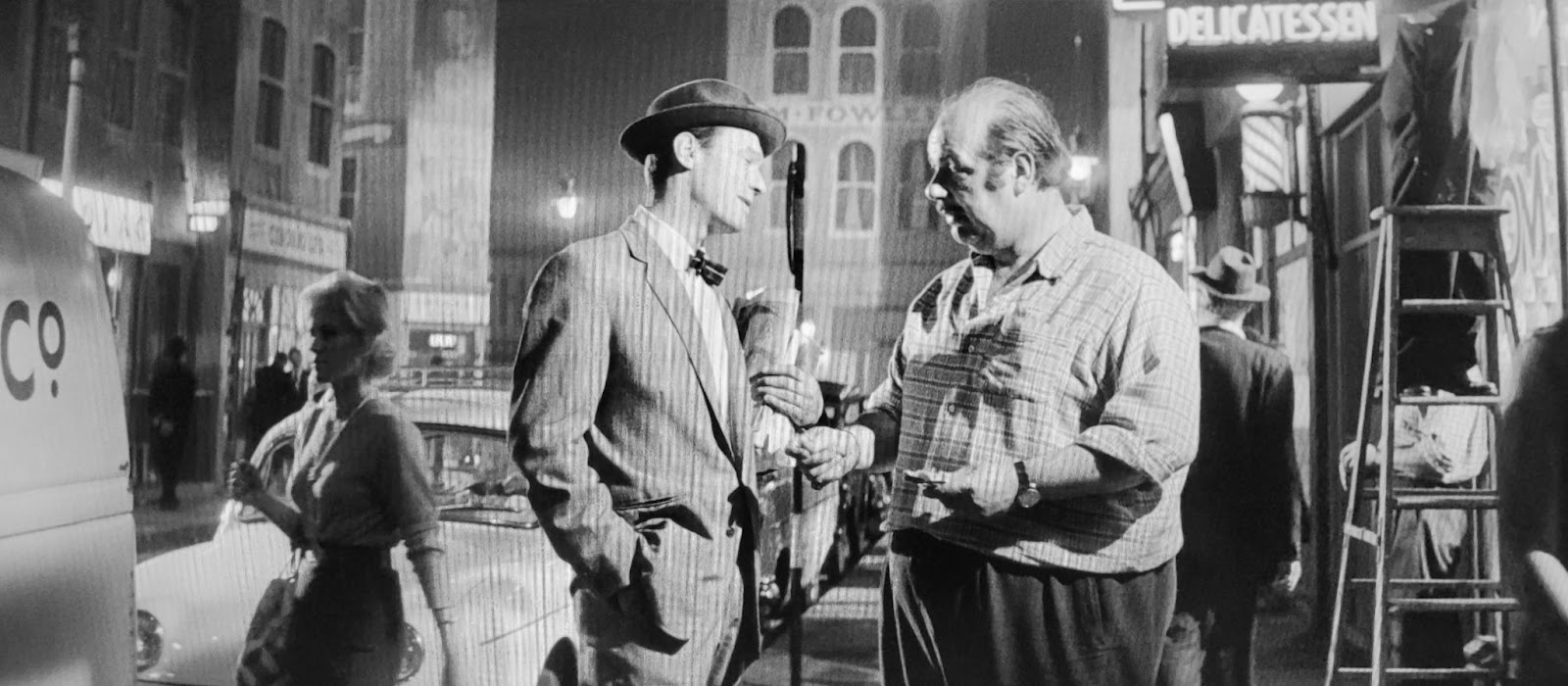
Part of that comes from its origin. The film Expresso Bongo, from director Val Guest, is based on a stage play co-written by Julain More and Wolf Mankowitz (who adapted the play for the screen) which was reportedly a more scathing indictment of the business side of the music business than the films ends up being. The bones of this earlier, knives out version are there: Johnny (Lawrence Harvey) is a schemer. He manipulates and puts pressure on his friends along the local London high street, trying (and frequently succeeding) to get something for nothing from them, promising to pay them back later. He’s like Wimpy from Popeye, but predatory.


Johnny “borrows” some newspapers and music magazines (presumably for research into the latest trends) from a kiosk, manages to talk deli owner Leon (Eric Pohlmann) into paying  *him*  for sandwiches, and repeatedly tries to duck out on his responsibilities to his ladyfriend Maisie (Sylvia Syms), a local burlesque performer who is patiently waiting for Johnny to further her career. You see him, through mental gymnastics and charm, stringing these people along and you understand that this isn’t new behavior.


But Johnny’s not a bad guy necessarily. He takes advantage of people when there’s an advantage to be taken, but he doesn’t cheat them. When he’s picking up his sandwiches from Leon’s, we see that the shop is under renovation and hear Leon lamenting the effect it’s had on his bottom line. Johnny sees this as an opportunity and offers to have one of his clients perform there next week to help draw in business - the fact that he currently does not have any such clients is, for Johnny, a minor detail that he has the utmost confidence he will be able to rectify shortly. And to be honest, he does.


Enter Bert Rudge (actual British pop star of the era Cliff Richard) who just wants to hang out at the local coffee bar, be handsome, play bongos, and occasionally, when pressured, sing a little bit. Honestly: same. But once Johnny sees how talented he is, and how gaga he drives the youths, Johnny is on a mission: to get as much out of the kid as he can. So he gives the kid a quick polish. First and foremost, a name change. Goodbye “Bert Rudge” and hello “Bongo Herbert” (yes, seriously - but I’m sure you’ll agree it’s an improvement).


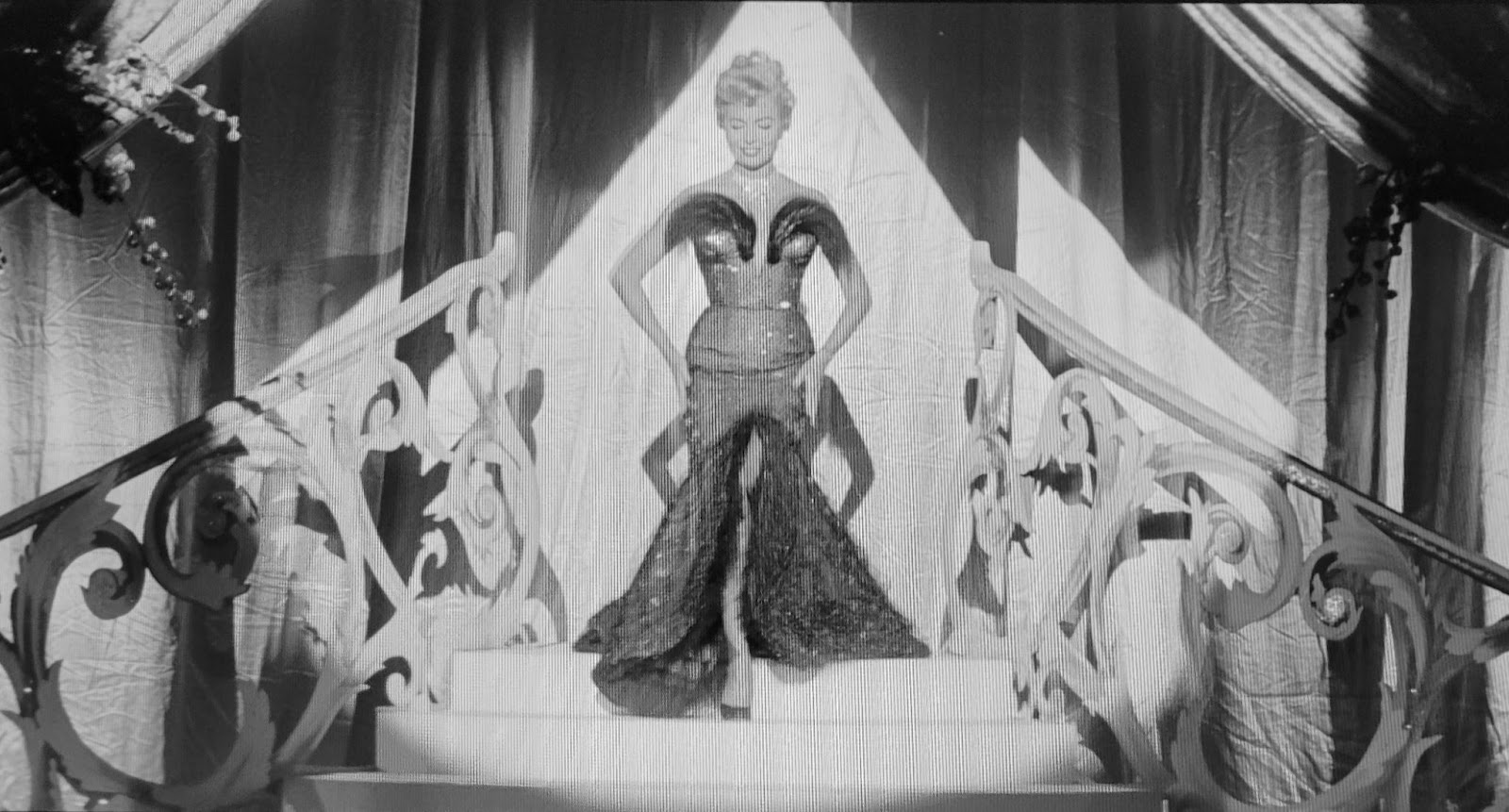
Always looking to capitalize on opportunity, Johnny eventually spins “Bongo Herbert” into the aforementioned international singing sensation. Not through any grand machinations, but by recognizing his moment and seizing it. When Maisie’s burlesque troupe (who in 1959 are discussing unionizing - good for you, ladies) appear on television to perform their Historical Honeys routine (clothed of course), Johnny manages to get the broadcast van down to Leon’s place in time to see Herbert perform, which just so happens to be when record executive Mr. Meyer (Meier Tzelniker) is there. So in just a few days’ time, through a mind boggling level of plate-spinning, Johnny has found a talent, rebranded him, signed a contract (more on that later), gotten the kid on TV, and gotten a record exec interested. That is  *so many*  irons in the fire, it would make Howard Ratner (Adam Sandler in Uncut Gems)’s head spin! Working as hard as he is, isn’t Johnny entitled to his fair share? He certainly thinks so, and in fact the share isn’t really all that fair. By talking a mile a minute, he manages to convince both of Bert’s parents to sign a contract that entitles him to  *half*  of what Bongo Herbert makes!


As his star shines ever brighter and the financial stakes grow larger, more and more people want a piece of Bongo Herbert. Record exec Meyer wants a cut of that 50/50 contract (or more), Meyer’s current big star Dixie Collins (Yolande Donlan) wants to use Bongo to boost her own, somewhat fading celebrity. You can see how the play could use these “do the ends justify the means?” concepts to really take the piss out of the music industry. It seems the only thing preventing the film from doing the same is its star.


By casting an actual factual celebrity musician, who had undergone a similar name change (Cliff Richard was born Harry Webb), the ability of the movie to simultaneously be a critique of the music biz  *and*  a vehicle for elevating the career of it’s singing star ceased to be a tightrope worth walking. Apparently the songs performed by the stage version of Bongo Herbert were a lot more cutting and satirical, while the ones performed by Cliff Richard in the film were chosen to showcase his abilities and charm. The only one to make the transition from stage to screen was The Shrine on the Second Floor, which Herbert performs as one act on Dixie’s big variety show. Allegedly in the stage version, it plays as an overexaggerated parody of the Songs For Mama subgenre popular with crooners of the time, only in the film Richard sings it straight and earnest, robbing it of its apocryphal intended sting.


In the end, Bongo has been freed from his contract with Johnny but will potentially end up in a situation that’s not much better with Meyer representing him because fundamentally Bongo hasn’t changed. He was never much interested in stardom, only wanting to play the bongos. Which brings me to a minor problem I have with the film: not enough bongos! I don’t know if any of you reading this have bongo experience but they’re hard to play well (though they  *are*  fun no matter how good you are) and I was looking forward to, perhaps an extended bongo solo? Though I suppose the era of satirizing musical excess was still a ways off.


That one quibble aside, Expresso Bongo really works for me. The cast all deliver the zippy dialogue with aplomb, frequently while performing other complicated actions (like burlesque numbers, or dressing and undressing during a split-screen phone call). It’s frankly incredible. The dialogue specifically is very interesting. It isn’t pithy one liners or rat-a-tat Billy Wilder -style dialogue, though it comes close. Rather, it’s acrobatic mouthfuls that circle around, referencing themselves. They’re still snappy but really most only shine in the full context of a scene where you can appreciate what they’re making allusions to and better absorb the whole interplay between characters.


There’s also the singing. Besides the number of diegetic songs performed by Bongo (Cliff Richard is charmingly unconcerned with properly lipsyching), Dixie, or the burlesque troupe (their number You Can Look at the Goods But Don’t Touch has strong We Put the Spring in Springfield vibes), the characters themselves break into musical asides such as Meyer’s lament of youth culture Nausea, or Maisie’s also-lament of her mostly one-sided relationship Hate to Love You.


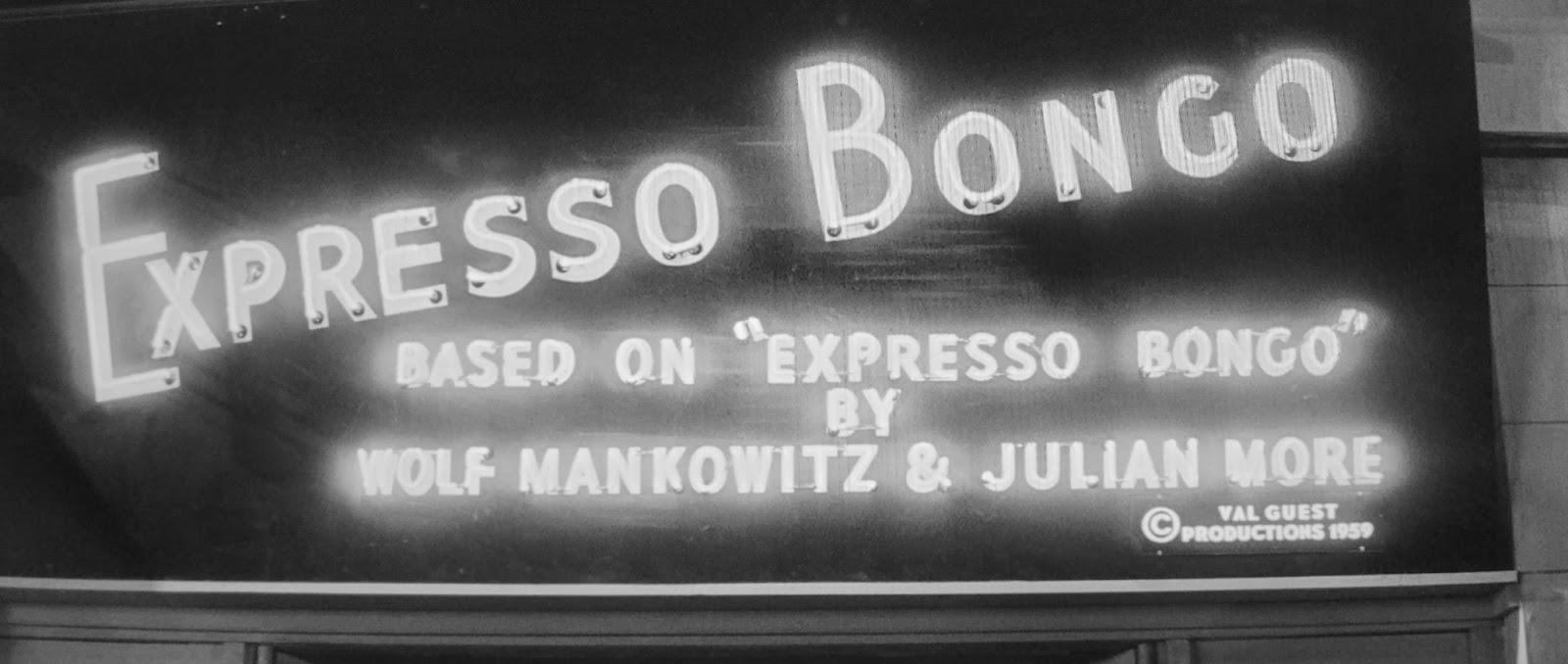
Last but not least, the transfer on the Kino Lorber / Cohen Media release is absolutely beautiful. Though the film is presented in black and white, everything is wonderfully crisp. The depth of the ostensibly monochromatic palette is stunning, with every pattern and texture on full display. The opening credits are presented as a tour up and down the high street, with actors’ names depicted in neon lights, on the light-up signs of businesses, on menus, and even on a sandwich board (allegedly worn by writer Wolf Mankowitz) and none of it looks washed out or degraded in the slightest bit. Similarly the audio is fantastic. There’s no hiss, no crackle, nothing like that. I still threw on the subtitles but that was to deal with the triple threat of Accents, Slang, and Rapid Dialogue which could have been a greater hurdle without the aid of, as Bong Joon-ho sarcastically refers to them “The one inch barrier of subtitles”. Me & Bong: Team Subtitles all the way.


If you come to Expresso Bongo for the bongos, know that you’re going to be a little disappointed, but in literally all other regards, it’s a fully enjoyable viewing experience and a beautiful transfer.


Expresso Bongo is available on Blu-ray Jan. 18th from Kino Lorber. You can follow me on twitter, instagram, or letterboxd.

Thursday, June 18, 2020

"VAMPIRE BURT'S SERENADE" (2020)

A Vampire Movie with No Stakes

Vampire Burt's Serenade 
Written and directed by Ken Roht
Starring Kevin Scott Richardson, Sharon Ferguson, Brandon Heitkamp, Diva Zappa
Running time: 1 hour 16 minutes
Unrated, but contains graphic language, toothless sexual content, obnoxious drug use, cartoonish violence and instances of mild monsterism.

by: Hunter Bush


When a vampire kills the MC of a popular strip club, the strippers set out to get revenge by surprising the vampire where he'd least expect it: picking up drugs from his dealer. That pretty-well sums up Vampire Burt's Serenade in a nutshell, though there is more than that going on. Much more. Some would say too much more. I am one of them.


Monday, July 31, 2017

"Dancer in the Dark (2000)"

————————————————————————————————
In April 2017 I engaged in an interesting film viewing experiment.
Myself and Nikkolas Nelson another MovieJawn reviewer,
watched DANCER IN THE DARK together via smart phone.

The following is a brief thesis of the film that I submitted.
Plus some pictures for added pizzazz.
The final article is very different by necessity & can be found in the Moviejawn zine
(Vol. 3, #5) which may be available here in the Moviejawn shop.
————————————————————————————————


DANCER IN THE DARK (2000) (thesis)
for: MovieJawn
by: Hunter Bush


“I love the movies. I just love the musicals.”
“But isn’t it annoying when they do the last song?”
“Why?”
“Because you just know when it goes really big… and the camera goes like out of the roof… and you just know it’s going to end. I hate that. I would leave just after the next to last song… and the film would just go on forever.”


DANCER IN THE DARK is a beautiful and bleak film, which I knew that going in. Selma (Björk)’s life is filled with day to day troubles; she’s a single mother of a mildly disobedient son and she works a relatively joyless factory job to pay rent to the police officer and his wife (David Morse & Cara Seymour) who are her landlords. Oh and, some time this year, she’ll be blind. It’s no wonder she retreats into elaborate technicolor musical numbers in her head to cope. They can make a day spent working in a factory fly by quickly or even, in Selma’s mind, resurrect the dead and offer their killer some forgiveness.


The quote at the top is Selma explaining to Bill (Morse) the way she chooses to watch movies. She knows that the movie will end and that’s just how things are, but she chooses to ignore that objective reality in favor of a less painful subjective one. This is writer / director Lars von Trier boiling Selma down to her bare bones: rather than face this minor unhappiness, she reshapes her reality into one that she prefers. One where the musicals are all still going; songs still being sung and choreographies performed, where the curtain never comes down. 


When I was given this film by a friend, he said I should “…only watch it if you want to ruin your day.” and while that’s not wrong, it isn’t wholly right either. For all the miseries in DITD, it’s also filled with magic, beauty and hope. I expected to never feel the need to watch this again, but I can say that I absolutely will… I may just leave before the last song.